
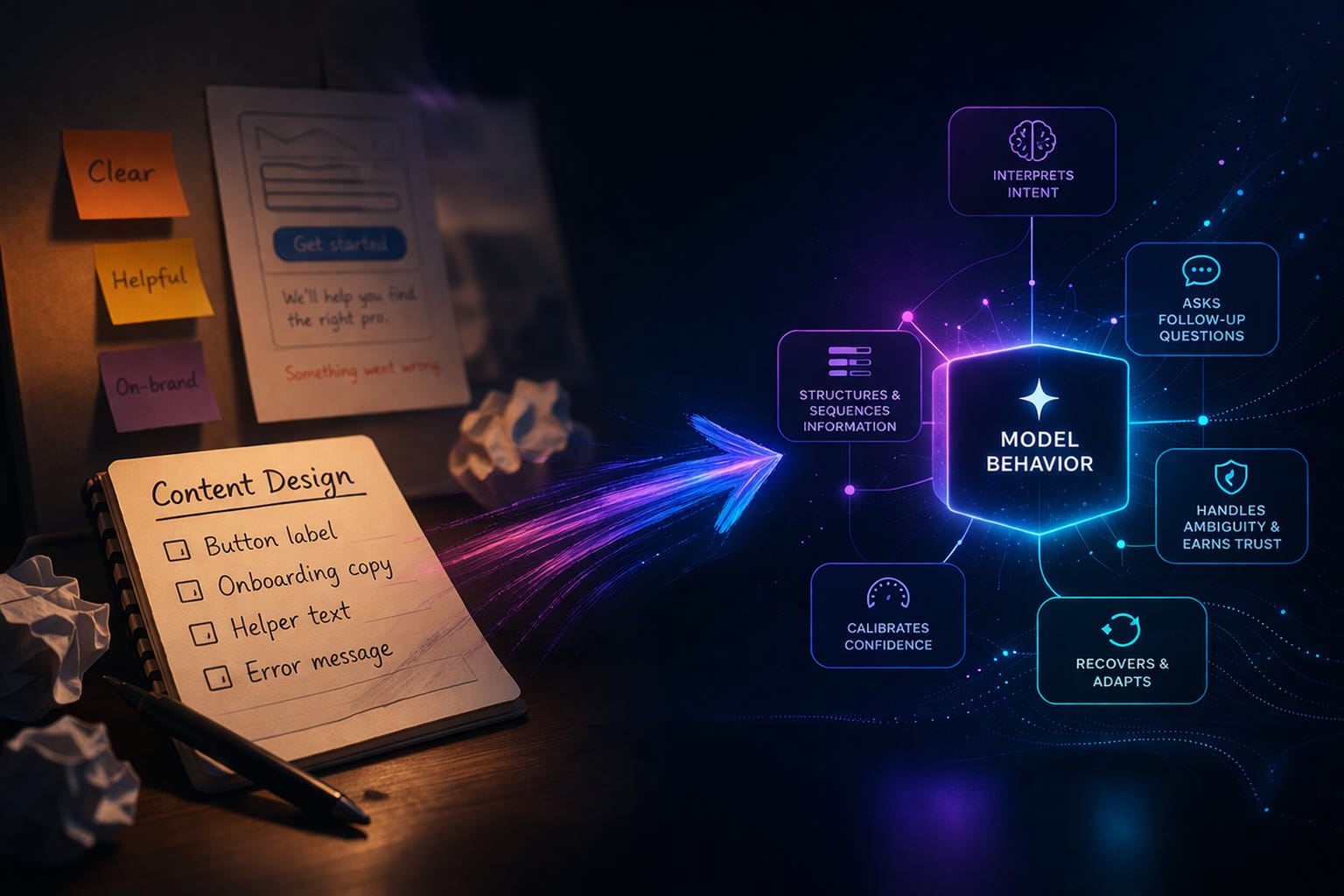
Image generated by ChatGPT, natch.
A year ago, I wrote that content engineering was the future of content design.
I still believe that. But I don’t think it goes far enough anymore.
Because what’s becoming clear now is that we’re not just engineering content systems. We’re designing model behavior.
From words to models
For a long time, content design showed up in the interface: button labels, onboarding copy, helper text, error messages. But the work itself was always bigger than the artifact. It was about making complex systems understandable. It was about shaping clarity, flow, meaning, trust, and a user’s ability to move forward with confidence.
Now AI-powered products have changed the artifact.
Instead of a fixed interface, we’re increasingly designing for generated responses, recommendations, follow-up questions, explanations, and conversations. The output is dynamic. The interaction is less scripted. And the communication layer is no longer something you fully write line by line.
Today, the most important content decisions are no longer about what a product says in a given moment. They’re about how the system communicates overall: how it interprets intent, handles ambiguity, sequences information, expresses confidence, explains itself, and earns trust.
That isn’t just a new toolset. It’s a new design layer. And it’s one we’re actively designing for at Thumbtack.
As the company moves further into AI-powered experiences, we’re shifting from content design to content model design because the highest-leverage content decisions are happening upstream. More and more, the work is about shaping the systems that generate communication, not just refining the output after the fact.
“More and more, the work is about shaping the systems that generate communication, not just refining the output after the fact.”
And that creates room for a different kind of impact.
Content engineering was the bridge
Content engineering gave us a way to talk about the move from static content to dynamic systems.
It gave us language for prompts, structured inputs, taxonomies, evaluation criteria, and all the messy in-between work that never fit neatly under “UX writing.” It helped explain why content designers were suddenly working closer to systems, logic, and model outputs.
That framing was useful. But as AI products mature, I think we need language for the next layer of the work.
This is content model design
Content model design is the practice of designing how AI systems communicate in product experiences. It includes the language itself, but also the patterns, rules, structures, and quality standards that shape that language over time.
How does the model interpret user intent?
When does it ask a follow-up question?
How does it handle ambiguity?
How does it explain a recommendation?
How does it calibrate confidence?
How does it recover when it gets something wrong?
How does it stay useful without becoming overbearing?
If content design asked, What does the user need this interface to say?
Content model design asks, How should this system communicate?
Why naming this matters
I care about naming this shift because naming shapes how work gets valued.
If we name the work for what it actually is, the scope becomes harder to ignore. This is not just copy review. It’s not just prompt writing. It’s the work of shaping how AI systems communicate with people: how they create understanding, reduce friction, build trust, and make a product feel coherent, useful, and safe.
“It’s the work of shaping how AI systems communicate with people: how they create understanding, reduce friction, build trust, and make a product feel coherent, useful, and safe.”
The future is systemic
I don’t think the most interesting question is whether AI will write for us. It will. It already is. And that’s fine.
At Thumbtack, part of this shift is about making it easier for teams to generate high-quality static content through shared tools and infrastructure, instead of routing every piece of content through a content designer by default. That changes the job in a fundamental way.
When content creation is democratized, the highest-value work is no longer touching every word. It’s designing the systems that make those words useful, coherent, trustworthy, and scalable.
Content model design moves the work from artifact creation to system design. From polishing outputs to shaping how outputs get produced in the first place.
This is the birth of a new discipline. One with more influence on product strategy, more impact on product quality, and more power to shape how AI actually works for customers.
Your question about recovery suggests a useful evaluation case: give the model a failed action whose cause is unknown. Does its reply keep that uncertainty, or invent a reassuring diagnosis? I would also check whether it distinguishes confirmed saved work from work whose status it cannot verify. A response can sound calm and helpful while still sending someone into an unnecessary retry. Those checks would make recovery behavior something a content team can test alongside tone.
Meta calls them “context engineers”